









I. Machine Model, Name, and Quantity
1. Purpose and Function The PB6-3600/13000 Electro-hydraulic Servo JCO CNC Pipe Press Forming Machine has a nominal pressure of 36,000 kN (Steel pipe processing length: 12,700 mm). It consists of the main machine, molds, longitudinal conveying device, front and rear CNC feeders, front and rear support racks, side discharge machine, CNC system, and hydraulic system. The slider is synchronized driven by 2 cylinders, with a positioning accuracy of ±0.03 mm and a repeat positioning accuracy of 0.02 mm. This machine adopts the JCO process and can complete multiple functions such as automatic feeding, bending forming, and automatic discharging. It can continuously and automatically produce open pipe billets for large longitudinal seam pipes. It is a large-scale bending forming unit in the production line of large longitudinal seam pipes.
نموذج: PB6-3600/13000
اسم: Steel Pipe Forming Machine
Quantity: One Unit
II. Machine External View
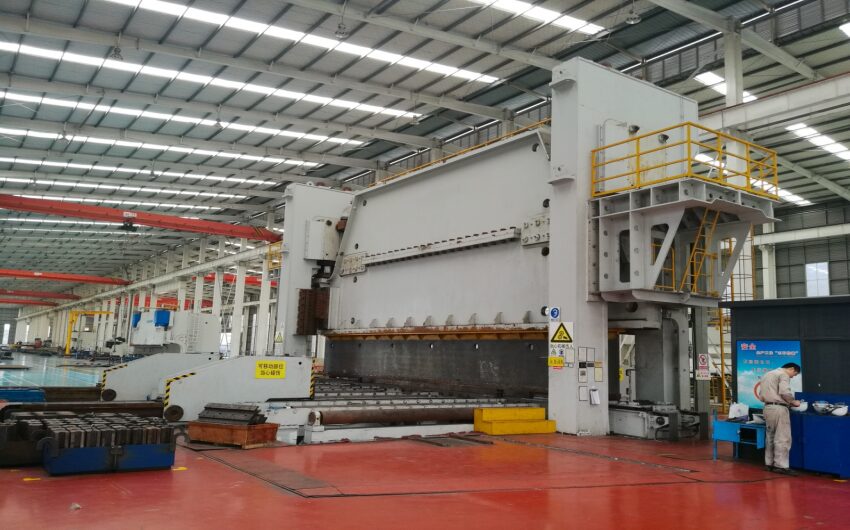
(Images for reference)
III. Main Technical Parameters
لا. | اسم | وحدة | معامل |
|---|---|---|---|
1 | الضغط الاسمي | كن | 36,000 |
2 | Effective Inner Spacing | مم | ≥13,000 |
3 | Upright Side Throat Depth | مم | 1,850 |
4 | Slider/Cylinder Stroke | مم | 1,000 |
5 | Max Open Height (Top of upper die to bottom of lower die groove) | مم | Approx. 2,550 |
6 | Slider Running Speed: | خلية | خلية |
خلية | No-load Speed | مم/ثانية | 70 |
خلية | سرعة العمل | مم/ثانية | 8 |
خلية | سرعة العودة | مم/ثانية | 70 |
7 | قوة المحرك الرئيسي (محرك سيرفو) | كيلوواط | 5 × 40.8 |
8 | Oil Tank Volume | ل | 6,000 |
9 | مبرد الزيت | خلية | 2 |
10 | Main Cylinder | خلية | 2 (Subject to detailed design) |
11 | Max Working Pressure | MPa | 26 |
12 | نظام CNC | خلية | خلية |
خلية | نموذج | خلية | DA66S |
خلية | Number of CNC Axes | خلية | 6+1 (Y1, Y2, X1, X2, X3, X4, V1) |
13 | Equipment Dimensions | خلية | خلية |
خلية | Length (including discharge rollers) | مم | Approx. 32,000 |
خلية | Width (including auxiliaries) | مم | Approx. 19,300 |
خلية | Height above ground | مم | Approx. 9,800 |
خلية | Depth underground | مم | Approx. 5,700 |
14 | Slider Main Plate Thickness | مم | 140 |
15 | وزن | طن | 730 |
IV. Description of Technical Advancedness
·Adopts the most advanced international design concepts to ensure high rigidity and high reliability of the machine. Main components are analyzed and optimized using ANSYS and UGS\CAD\CAE\CAM 3D software. Utilizes multiple patented technologies.
·Autonomous Manufacturing: Main components undergo integral annealing for stress relief. The machine's uprights, slider, and worktable are processed in one setup using large floor-type boring and milling machines and grinders to ensure parallelism and perpendicularity of all mounting surfaces.
·Cylinder Sealing Structure: Adapted for fast/slow speed conversion without leakage. The cylinder and slider use a spherical floating connection, allowing 360-degree adaptive contact for uniform force distribution, eliminating impact vibration during slider operation.
·Main Guide Rail: Adopts a reinforced four-column eight-face rectangular sliding guide rail with self-lubricating function and lateral rotation guidance. This avoids side forces on the cylinder and impact from lateral closing forces, making movement more reliable.
·Worktable and Slider Design: Adapted for high specific pressure conditions for both long and short workpieces, capable of withstanding strong load conditions for forming short and thick workpieces.
·Piping: Uses large-diameter piping with streamlined layout and reliable sealing to minimize impact vibration.
·CNC System: Stores more material properties for more flexible operation.
·Upper Die Handle: Tapered (larger at top, smaller at bottom) to adapt to the forming needs of conical workpieces. The lower die template has a large arc to ensure a more beautiful workpiece forming arc; the lower die has high rigidity to ensure workpiece straightness.
·Lower Die Material Support: A material support device is arranged in the center of the lower die. One type assists in feeding the workpiece forward and backward, and the other lifts the workpiece during discharge to avoid friction between the workpiece and the lower die, ensuring smoother discharge.
·Discharge Mechanism: Adopts a high-strength reciprocating discharge mechanism. Driven by a jog button, the workpiece is discharged laterally, ensuring smooth and reliable operation.
V. Functions and Accuracy of Machine CNC Axes
Machine Slider Y1, Y2 Axes:
·Slider motion control axes, controlling bending depth and bending angle. A closed-loop control system consists of the CNC system, two grating scales (Y1, Y2) installed on the worktable, electro-hydraulic proportional valves, and valve electronic amplifiers. It accurately detects and controls the relative position of the slider and worktable, controlling the speed and position of the slider. This keeps the slider running synchronously, ensuring bending depth and angle with high synchronization accuracy.
·Slider Positioning Accuracy: ±0.03 mm
·Slider Repeat Positioning Accuracy: 0.02 mm
Worktable Deflection Compensation Device V Axis:
·Worktable wedge compensation device, CNC controlled. It enables the worktable to form an ideal crowning curve to compensate for the deflection deformation of the slider and worktable. This achieves satisfactory deflection compensation, ensuring consistent angles along the length of the folded workpiece and improving part accuracy.
Front and Rear CNC Feeding Axes (X1, X2, X3, X4):
·The front and rear feeders are located on the front and rear sides of the main machine, respectively. They consist of rack and pinion rails, feeding trolleys, and transmission systems. They complete the feeding and positioning of the sheet metal. Under CNC control, the feeding trolley can achieve fast push feeding, working speed feeding, and positioning.
·Feeding Accuracy: ±0.3 mm
VI. Machine Anti-Eccentric Load Capability
The electro-hydraulic proportional servo system of this machine is a position control system. It can dynamically detect the synchronization error of the slider through grating scales. The proportional valves of the hydraulic system correct the synchronization error, ensuring the slider remains parallel to the worktable even under completely eccentric load conditions.
VII. Main Structure of the Machine
The machine consists of the main host, deflection compensation mechanism, molds, longitudinal conveying device, front and rear CNC feeders, front and rear support racks, side discharge machine, CNC system, and hydraulic system.
1. Main Host
·Structure: Adopts a gantry frame structure, consisting of uprights, crossbeams, worktable, slider, guide rails, cylinders, etc.
·Rigidity: The equipment has sufficient static and dynamic rigidity verified through finite element analysis. The split connection structure for large press brake workpieces has obtained a national patent (ZL 2009 2 0222143.1).
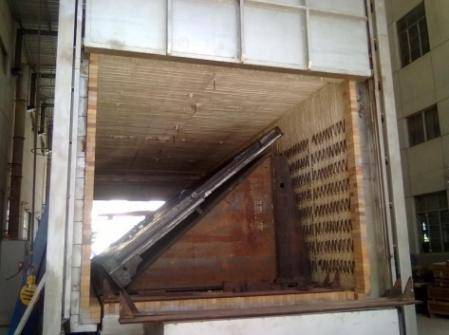
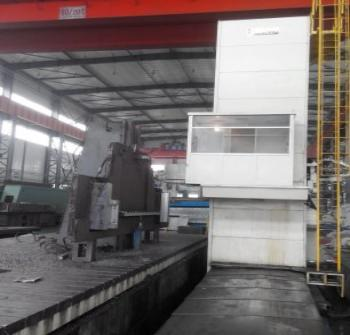
·Fabrication: The equipment is an all-steel welded structure connected by screws/bolts, featuring high strength and good rigidity, and is easy to disassemble and transport. Critical welds undergo flaw detection (NDT) with reports provided. Aging treatment is performed immediately after welding to thoroughly eliminate welding stress, ensuring stable and reliable accuracy. All machining surfaces are precision machined on large CNC machine tools.

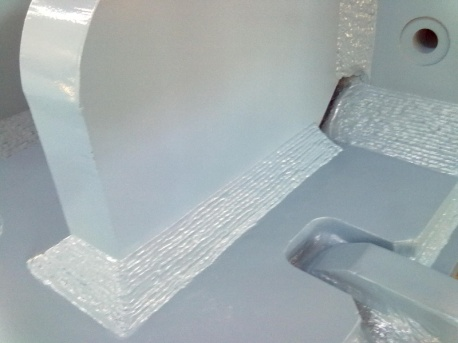
·Weld Quality: Welds are free from defects such as undercuts, pores, and cracks. External surface welds undergo strict process treatment and are painted directly without putty application.
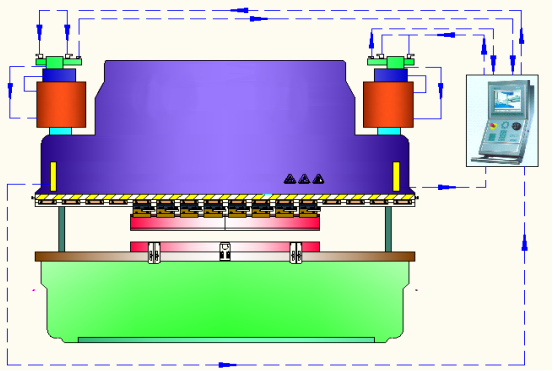
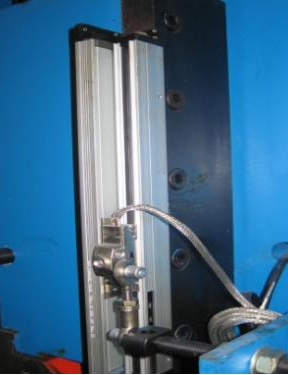
·Drive: Hydraulic upper drive. Two cylinders (Y1, Y2 axes) work synchronously to control bending depth and angle. High-precision grating scales (resolution 0.005mm) are installed at both ends of the machine to detect the relative distance between molds. The grating scales are connected to the worktable via C-frames so that upright deformation does not affect positioning accuracy. Position data is fed back to the CNC system in real-time. Y1 and Y2 are two independent hydraulic axes capable of independent programming.
·Slider Guidance: The slider is guided over its full stroke by Left/Right/Front/Rear "Four-Column Eight-Face" guide rails mounted on the uprights. The rails feature lateral guidance. The main guiding areas are equipped with guide plates made of wear-resistant material to prevent wear caused by dry friction and protect major components from direct wear. This ensures smooth and accurate movement throughout the up and down motion. This guiding system is a national invention patent of our company (ZL2009 1 0261552.7).
·Piston Rod and Slider Connection: أ Spherical Floating Support connection is used between the piston rod and the slider. This ensures that during bending, the piston rod does not receive lateral force due to elastic deformation of the uprights and slider, thus maintaining sealing performance and increasing the life of the cylinder, piston, and seals. It makes it easier to achieve tilted movement of the slider for bending special workpieces. This connection method obtained a national invention patent (ZL2012 1 0526791.2).
·Worktable and Upright Connection: A "Spherical" structure is used for the connection between the worktable and uprights. This ensures that deformation and pressure on the worktable and uprights caused by bending loads are resolved, avoiding abnormal deformation when the machine is under load.
·Sealing: The main hydraulic cylinder motion seals adopt the internationally advanced U-shape + Glyd Ring sealing structure; adapted for no leakage during fast and slow operation conditions.
2. Molds
2.1 Upper Die:
1.Backing Plates: The machine is equipped with 3 sets of upper die backing plates.
Set 1: Standard upper die backing plate, mainly used for bending all pipe diameters. The die handle is tapered (larger top, smaller bottom) for easy discharge. Different die heads can be changed to process different workpieces.
Set 2: Upper die backing plate for closing (crimping) open pipe billets (Pipe diameter Ø219-Ø914).
Set 3: Used for bending Ø219-Ø406 pipe diameters (small pipe opening, facilitating subsequent seam welding). This backing plate is installed onto the closing upper die backing plate.
The die handle allows for quick installation and disassembly.
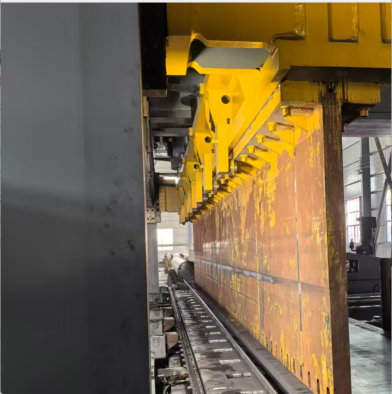
2.Die Heads: The machine is equipped with 3 sets of die heads.
1.Set 1: Dedicated die head for closing.
2.Set 2: R120, suitable for forming small diameter pipes.
3.Set 3: R260, suitable for forming large diameter pipes.
2.2 Upper Die Backing Plate Replacement:
·A guiding mechanism is installed on the slider to facilitate the replacement of upper die backing plates.
2.3 Lower Die:
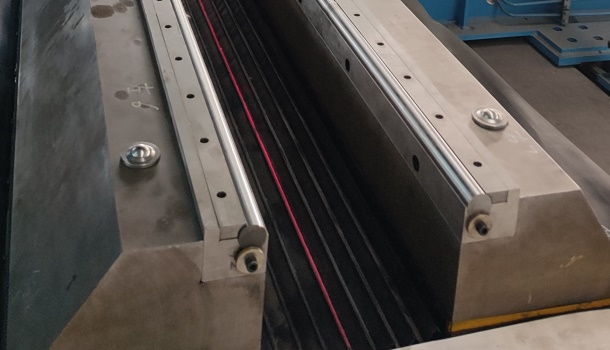
·Equipped with one set of automatic opening lower die. This die can achieve 10-500mm automatic opening or be designed according to workpiece requirements.
·One side of the lower die template is installed with Non-indentation Roller Bars for 90-degree right-angle forming to avoid scratching the workpiece. The round roller hardness is HRC60.
·The other side of the lower die template uses a large arc surface for steel pipe forming to reduce scratches. The large arc die opening radius is R120mm (specific die arc detailed design to be determined during drawing review).
2.4 Lower Die Lifting Mechanism:
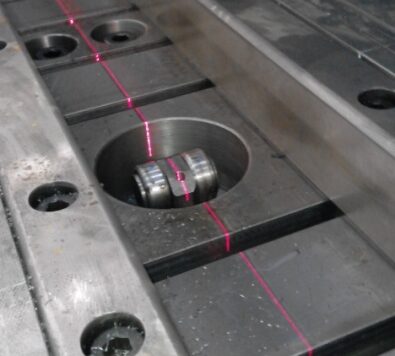
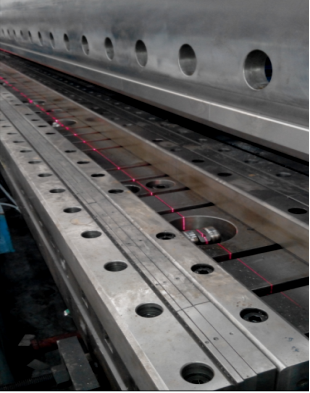
·There is a hydraulic cylinder lifting mechanism in the center of the lower die. It serves two purposes: feeding and discharging.
·The feeding lifting mechanism assists in feeding.
·During discharge, it lifts the workpiece (Not applicable when lower die slot opening is less than 160mm) to prevent direct contact with the lower die. This is our company's patented technology.
2.5 Pre-bending Capability:
This machine only pre-bends steel plates with a thickness of 20mm or less.
3. Deflection Compensation Mechanism (Crowning)

1.Adopts a three-layer compensation mechanism structure installed between the worktable and the lower die.
2.Longitudinal: Consists of a full-length wedge block composed of wedge shapes. Overall adjustment is controlled by CNC as an axis. The system automatically calculates and sets control, running automatically to the required position based on set parameters.
3.Transverse: Uses multi-point manual adjustment, allowing the worktable to form any ideal crowning curve.
4. Auxiliary Mechanisms
Consist of the longitudinal conveying device, front and rear support racks, front and rear feeding mechanisms (CNC axes X1, X2, X3, X4), ejection discharge device, and discharge mechanism.
4.1 Longitudinal Conveying Device:
·Consists of multiple active rollers (Φ269mm, rubber-coated, to be confirmed in drawing review) and lifting mechanisms.
·Active rollers drive the sheet forward. Position is controlled via encoder detection. Once in position, the conveying rollers descend, and the sheet lands on the fixed support rack.
·Located at the front of the main machine, connecting with the discharge rollers or transition rollers of the pre-bending machine.
·Workflow: After the sheet enters from the pre-bending machine, rollers drive it to the middle position length-wise. Then rollers descend, placing the sheet on the front support rack.
4.2 Front and Rear Support Racks:
·Located on the front and rear sides of the main machine, distributed evenly along the length. When conveying rollers descend, the sheet rests here. During feeding, the sheet is supported by these racks.
·Equipped with nylon plates to allow the steel plate to slide during feeding, improving positioning performance and preventing surface scratches.
4.3 Front and Rear Feeders:
·Located on front/rear sides. Composed of rack, linear guide, feeding trolley, and transmission system.
·Under CNC control, the trolley achieves fast push feeding, working speed feeding, and positioning.
·The spacing between front and rear feeders allows for positioning of pipes as short as 6m. Feeder stroke is 5200mm.
·Ejection Device: Located inside the lower die. During the last few bends, it lifts the open pipe barrel off the lower die to assist the rear feeder in smooth feeding.
·Rotation: Front/Rear feeders have rotation mechanisms to facilitate rotating the steel pipe during closing/crimping.
4.4 Front and Rear Holding Device:
·Arranged in front of the machine molds. Used to cushion the impact of the sheet on the support rack during initial forming when the material falls.
4.5 Side Discharge Machine:
·Consists of hydraulic ejection device, discharge trolley, and side discharge rollers.
·Ejection device: Located in the lower die. Lifts the open pipe barrel from the lower die slot.
·Discharge trolley: Runs along the top surface of the lower die along the worktable length. Pushes the steel pipe onto the side discharge rollers located outside the bending machine.
·Side Discharge Rollers: Composed of multiple sets of active rollers. Controlled by encoder/CNC, the pipe stops automatically at the center position of the transverse transfer car.
·Rotation Rollers: Side discharge rollers are equipped with lifting rotation rollers (rubber coated). Before closing, the pipe opening is rotated to the 12 o'clock position to facilitate feeding.
·Closing Operation: The transverse transfer car places the pipe to be seamed onto the conveying rollers. When the active rollers feed half the pipe in, the pushing trolley (equipped with a pipe hook) i

قسم التحرير